Showing posts with label rehousing. Show all posts

Tuesday, October 25, 2016

Housing and Shelter Targets Exceeded as Haskell Encampment Closes; Street Outreach and Case Management Continues

Haskell Encampment, Dallas, Texas – Yesterday, October 24, 2016, the Metro Dallas Homeless Alliance (MDHA) and the Street Outreach Initiative, closed out an intensive week of case management and engagement, reviewing options with the remaining thirty-seven individuals, living at the Haskell Encampment, who had not moved yet. The encampment area located between S. Hill and Haskell Avenues under I-30 is in the process of being formally closed today, October 25, 2016.                                          

Street Outreach Initiative
Team Mobile Office
The site was slated for closure after a joint meeting with City Officials on September 29, 2016, when MDHA and collaborative partners agreed that the Street Outreach Initiative could reasonably house half of the then population of eighty-two encampment residents. The closure guidelines were developed by MDHA in consultation with the City of Dallas, following the clearing of Tent City in April-May of this year. As of yesterday, 45 persons have been placed, just above the goal of 41. 

Over the course of the last few weeks, in fact, MDHA and its partners from the City of Dallas, CitySquare, Nexus Recovery Center, Turtle Creek Recovery Center, The Bridge, Austin Street Center, the Salvation Army and Metrocare Services, were able to find and place forty-five residents into shelter, treatment, rapid rehousing, permanent private housing, and group homes or help them reunite with their families.

“Consistent and persistent case management, patiently undertaken by seasoned professionals, trained in trauma-informed care,  and armed with a toolbox of evidence-based solutions, is the only way we can end unsheltered homelessness in Dallas,” said Cindy Crain, President and CEO of MDHA. “The success of this effort could not be accomplished without strategic interagency collaboration, which has been developing over the course of 2016 into a true crisis response system, where we all work together, breaking down silos, and securing the best possible outcome for every individual,” she added.   

Yesterday, as case managers and volunteers helped the remaining residents pack up, they were joined by five formerly unsheltered homeless from prior tent encampment closures who are now permanently housed.

Crain reflected, “Their presence gave residents a glimpse of hope and possibility of the results of accepting shelter, housing, treatment and services. Seeing is believing, and is critical to motivating and working through the ever present trauma enforced fear and uncertainty of accepting assistance. The Street Outreach team gets better every day at the hard work that they do.”

MDHA and its partners will continue to work with these and other unsheltered individuals to get as many of them as possible off the streets and into shelter and housing. The overall impact of the successful, peaceful and housing-oriented closing of three encampments since the beginning of May 2016, will not be fully known before the annual Point-in-Time Homeless Count, which will be led by MDHA on the night of Thursday, January 26, 2017.

In the last Count, conducted on the night of Thursday, January 21, 2016, MDHA counted 539 unsheltered homeless individuals in Dallas. In order to conduct a full and accurate count of the unsheltered homeless, this coming January, MDHA will need 1,000 volunteers, registered as teams of 3-5 persons. Registration will open mid-November. Those wishing to receive notification of such, should text keyword MDHA to 22828 to join MDHA’s mailing list.

Tuesday, August 9, 2016

It’s Important to Do What Works

Opening Doors - the national strategic plan
to end homelessness
Sometimes folks tell us that we should not let HUD dictate what we do. Who are they, in Washington, to know what is right for us in Dallas?! Well, in fact, HUD does NOT dictate what we do; the evidence does. Decades of research, culminating in the landmark national strategic plan to end homelessness, mentioned above, Opening Doors, guide our work in every community. This plan came about through the specific contribution of 750 leaders and experts from around the country (including in our community), but also "through thousands of individuals (emphasis ours) who contributed online, in meetings, and in Agency analysis", whose "wisdom and experience helped determine priorities based on data, research, and results."

So, while there are certainly philosophical reasons to advocate for Housing First, not Housing Readiness, for Rapid Rehousing, not Transitional Housing (except for youth and domestic violence survivors), and for a coordinated homeless response system, rather than an uncoordinated homeless service environment, what really matters is that in each of these examples is that the former works, and the latter does not. We have to follow data, research and results. Would any other approach be fair to those we ultimately serve, those experiencing homelessness?  

Monday, May 9, 2016

Coordinated Access in Action in Tarrant County – Housing Inventory

This week we are publishing the remaining three blog posts in our Coordinated Access series. For the full picture, go back and read the first three, if you have not done so yet:


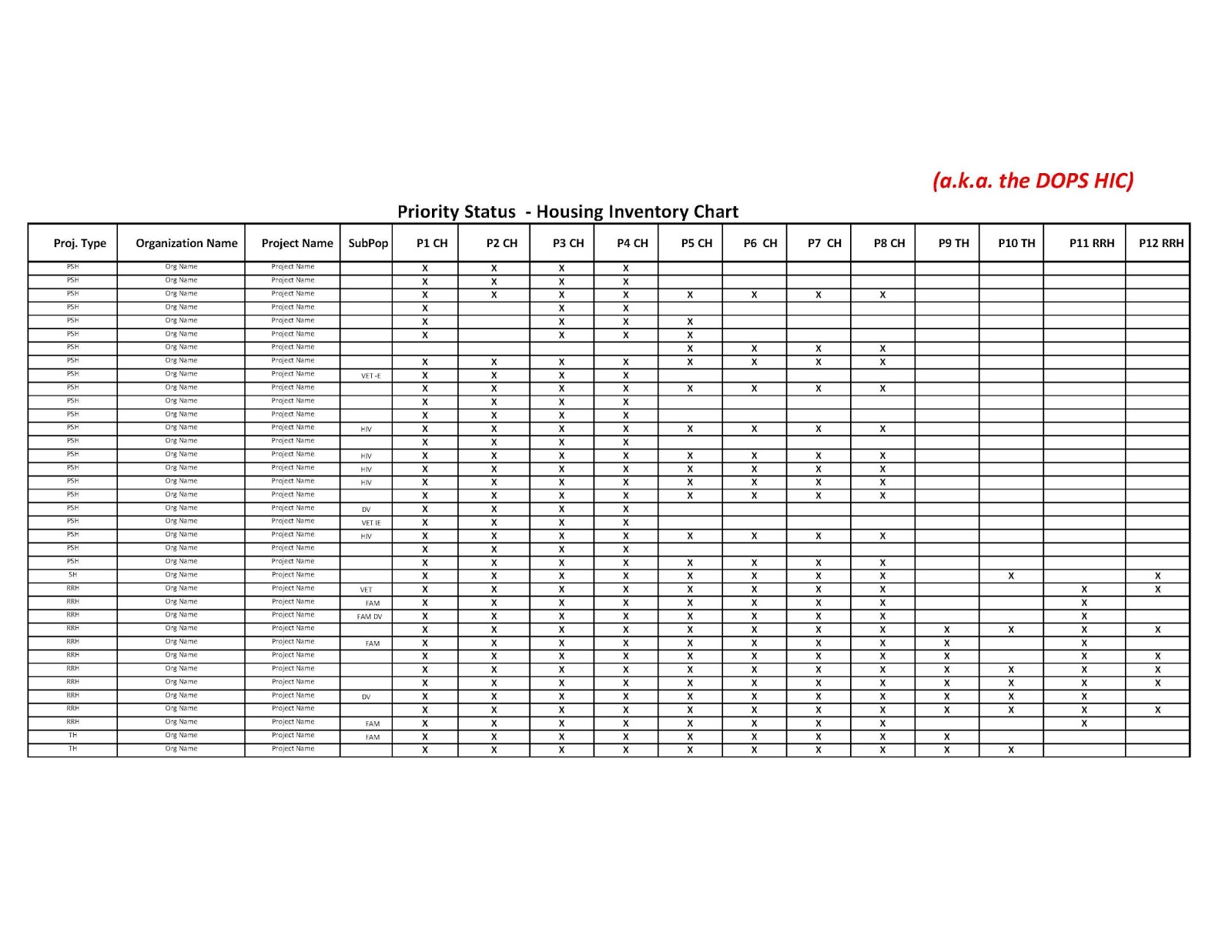
The counterpart of supply is demand. It does no good to streamline your supply (of persons), if the demand (housing units) side of the equation is not systematized. The TCHC team realized that this supply needed to be carefully managed in real time, as does any housing market. However, this task was much greater given the different types of housing stock, with different requirements and stipulations. Some housing is permanent supportive housing, some is transitional housing, and some is rapid rehousing. Some is for veterans and some is for persons with HIV/AIDS. Some is for single men and women and some is for families. And that accounts just for housing with formal programs for the homeless. Outside of this, there are housing units of public housing authorities, tax credit rental properties, second chance rental housing and more. Therefore, the TCHC created the Priority Status – Housing Inventory Chart (the DOPS HIC) to manage the supply, and know the real time status of each and every unit in the system, i.e. available, committed or filled. A full time Housing Inventory Specialist or HIC Specialist was designated to manage the chart, with all the nuances and requirements of the different types of units in it, and to make sure that units were filled quickly once vacated. However, as above, this was only part of that employee’s task. This person was also to find and manage units for those who did not have room in or did not qualify for units within the homeless response system. As a correlate to that, this person would also work on a “ready to rent” program for individuals who do not belong in the system itself, who can be certified through 18 hours of training, as “ready to rent” making them more attractive to landlords.
 
The TCHC version of the DOPS HIC:


Saturday, July 18, 2015

Duh!

There are complicated areas, where research ends up contradicting and flying in the face of common sense. The Freakonomics books, podcasts etc. are great examples of this. This always makes news too, since man bites dog is news, while dog bites man is not.

Then there is the issue of homelessness. I am surely not the first one to observe that though research is important, it ends up backing up common sense, almost always, so much so, that it leaves you saying to yourself and others, “Duh!” Homelessness is a result of poverty? Duh! Kids that grow up homeless are more likely to be homeless as adults. Really?! We can end homelessness by (wait for it…) housing people. Who’d have thunk it?!

The importance of research in the area of homelessness is not to tell us something we don’t know. It is to remind of what we do know, prod us to stop flogging dead horses, and get on with delivering solutions that really work. Daniel Patrick Moynihan may have said that you are entitled to your own opinion, but not your own set of facts, but we all know that today that seldom holds true. We need to be reminded of what the data indicates, so can get on with finishing the job of ending homelessness, instead of just managing it.

This study reported last week by the Seattle Times’ Caitlin Moran is a perfect example of this. The title is clearly in the dog bites man category, “Study finds housing vouchers best way to keep kids in same school.” The subtitle won’t make you fall off your seat either, “Students who change schools are likely to fall behind academically, and helping families get stable housing can prevent that.”

In the introduction to the study itself Katherine M. O’Regan, Assistant Secretary for Policy Development & Research, U.S. Department of Housing and Urban Development, says, “This report documents outcomes at 18 months, presenting striking evidence of the power of offering a permanent subsidy to a homeless family. Families who were offered a housing voucher experienced significant reductions in subsequent homelessness, mobility, child separations, adult psychological distress, experiences of intimate partner violence, school mobility among children, and food insecurity at 18 months. Moreover, the benefits of the voucher intervention were achieved at a comparable cost to rapid re-housing and emergency shelter and at a lower cost than transitional housing.”

To summarize the study, one word, “Duh!”

Tuesday, July 14, 2015

Rapid Rehousing is Resting Comfortably…

Dr. Iain De Jong
I spent years teaching in various formal and informal settings, from middle school through graduate school, from sitting around a campfire with kids to sitting down with doctors and teaching them continuing medical education. I always tried to emphasize that you always need to question what you are told, what you hear, what you read. I always cautioned that you need to keep in mind that very few issues have black and white explanations or silver bullet solutions. You must read between the lines, and always question the agenda, motive and point of view of the writer or speaker.

I mention this in light of the recent reports of the supposed demise and failure of Rapid Rehousing, not in some partisan rag, but on NPR (shudder!) Well, thankfully, Dr. Iain De Jong, of OrgCode, reminds us in an excellent blog post that, to paraphrase Mark Twain, reports of the death of Rapid Rehousing have been greatly exaggerated. If anything, when programs work properly, the evidence points to the very opposite. Read the full blog post here: Does Rapid ReHousing Work? Well, it depends.


While there, check out this cool video, which De Jong links to in the blog post, where he walks us through “Housing First 101”. Stay tuned for more to come in August about Dr. De Jong’s visit to Dallas. We will be hosting a Hard Conversation, where he will discuss this issue, in a talk entitled, “Who Deserves Housing First?”

Tuesday, February 24, 2015

Coordinated Access in Dallas

One of the most exciting programs MDHA is working on is Coordinated Access. What is it all about?

Research-Based

Research shows what solutions will prevent and end homelessness: diversion services (that help persons address their needs, while remaining housed), rapid rehousing and permanent supportive housing. Research further indicates that the availability of these solutions alone is not enough; communities need systems to coordinate delivery. This is why the U.S. Department of Housing and Urban Development (HUD) mandates that each community have a Coordinated Access system.

Person-Centered

In an uncoordinated environment, every service provider, "Will this person be successful in our program?" Assessment is diverse as service providers are, and persons with less severe needs/at less severe risk are often served first. Those with the greatest needs/at most risk, are turned away, and may fall through the cracks.

In Coordinated Access, the system asks, “What solutions best match the needs of this person?" Assessment is uniform, and person-centered data is collected. Coordinated Access scores, ranks and prioritizes persons for service, based on their levels of need/risk. It matches each person with the solutions that are the best fit for that person’s needs, and electronically refers them to service providers that deliver those solutions. It follows up to ensure that those solutions are delivered, and that persons with the greatest needs/at most risk, are served first.

How It Works in Dallas

Persons in need of assistance approach any system service provider. An Intake professional interviews the person using the Vulnerability Index-Service Prioritization Decision Assistance Tool (VI-SPDAT), which is built into the system. The system itself scores (the higher the score the greater the need/risk), ranks and matches the person with real-time available and appropriate resources, that can deliver the most appropriate solutions for that person. The intake professional, in consultation with the person, electronically refers him/her to service providers, who deliver those solutions. All collected data, scoring, matching and referrals are available to service providers on the system. Coordinated Access staff follows up to ensure that those solutions are delivered, and that those with the highest scores are served first, whenever possible.

Coordinated Access staff offers ongoing support and training, and monitors compliance and report generation. They pay close attention to patterns of need arising across the system, as well as provider–specific patterns. These create feedback loops for learning and improvement. Coordinated Access serves service providers in the homelessness arena, and will help the community meet HUD targets to end veteran, chronic and family homelessness in 2015, 2016, and 2020. The Dallas area CoC and MDHA envision a day, when many more service providers will be part of Coordinated Access, functioning as one, in the homelessness arena and beyond, delivering solutions that match each person’s needs.

Tuesday, January 27, 2015

Tarrant’s Homelessness Game-Changer Cindy Crain Shifts Focus to Dallas, Collin as MDHA’s New CEO

Dallas, Texas (Jan. 27, 2015) – Metro Dallas Homeless Alliance (MDHA), an association of organizations devoted to ending homelessness in Dallas and Collin Counties, announces today that Cindy Crain will join as its new president and CEO effective March 1, 2015.
 
Cindy Crain
Previously, Crain served for seven years as executive director of Tarrant County Homeless Coalition (TCHC) where she earned broad acclaim for radically transforming the organization’s operations and tackling homelessness in Tarrant County. While there, she led efforts to improve the central database used by more than 30 human services organizations to provide real-time knowledge of clients and shelters and more accurately match the needs of homeless persons with the most appropriate housing intervention. Recognizing case managers as being the most critical yet often under-supported person in leading someone in crisis to a life of stability, dignity and self-sufficiency, Crain also developed and implemented an extensive year-round training and recognition program for case managers assuring access to at least 15 continuing education credits for social work licensure.  During Crain's tenure at TCHC, the agency grew from one person to nine and from just over $100,000 to $1.4 million annually to provide extensive services to agencies serving the homeless. 
Larry James, president and CEO of CitySquare, MDHA board member, and Dallas Mayor Rawlings’ appointed leader of the city’s poverty task force, spearheaded search efforts that ultimately led to Crain.

“In our three-month search process, we were encouraged to see such a large pool of qualified candidates interested in leading Metro Dallas Homeless Alliance,” said James. “The organization has made significant progress over the past few years in reducing chronic homelessness. With our goal to end homelessness in Dallas and Collin Counties, it did not take long for us to realize that Cindy Crain is the perfect person for this job.” 

Britton Banowsky, Commissioner of Conference USA and MDHA Board Chair, echoed sentiments about Crain leading homelessness efforts in Dallas and Collin counties. 

"We are excited and so fortunate to have Cindy Crain lead our efforts to address homelessness in our community. She is a nationally recognized expert and proven leader in her field. She is also a wonderful and compassionate person. There is no doubt she will make an amazing positive impact to the organization, and in the lives of countless people throughout North Texas in the years ahead," said Banowsky

Before joining TCHC in 2004, Crain worked in Tarrant County and the City of Fort Worth. She holds a Master of Public Administration degree as a Graduate Fellow from the Maxwell School of Citizenship and Public Affairs, Syracuse University and a Bachelor of Business Administration degree from Texas Christian University. Crain succeeds former MDHA president and CEO Michael Faenza who announced his retirement October 2014 and consulted with the organization until January 1, 2015. 

About MDHA: The Metro Dallas Homeless Alliance (MDHA) is an association of organizations devoted to ending homelessness in Dallas and Collin Counties, by putting people into homes. It facilitates over $16.8 million of annual federal funding, coordinates services, and drives improvement in more than 40 different transitional housing, rapid rehousing, and permanent supportive housing programs. Since 2004, MDHA has overseen a reduction of 65% in chronic homelessness, and an increase of 1200% in permanent supportive housing units. It improved homeless housing program performance by 30% in just the last three years. Finally, it launched and operated The Bridge, a $28 million intake center for those experiencing homelessness, before spinning it off as a separate non-profit. It is committed to ending veteran homelessness and chronic homelessness in 2015 and 2016, respectively.

Monday, December 15, 2014

This Book Blew Me Away!

I just finished reading one of the best books I have ever read. It just blew me away.

The book, which came out this year, is No Greatness without Goodness – How a Father’s Love Changed a Company and Sparked a Movement. It is the story of former Walgreens Senior Vice President, Randy Lewis, which he tells in first person. Raising an autistic son inspired him to lead Walgreens towards a reality, where 10% of their workforce is made up of persons with disabilities. He did this without sacrificing anything on the business end of the ledger. He is emphatic about the fact that this can work in any company, and in fact has inspired other companies to do the same as Walgreens. He insists that this is all out of a sense of justice, not charity.

Since when you are a hammer everything is a nail, while reading this I obviously reflected on what this might mean for our fight to end homelessness. Homelessness is primarily an issue of poverty, while chronic homelessness, is an area where poverty and disability meet and exacerbate each other. Could such policies, like the one Lewis led at Walgreens, help in this area? I can’t see why not. He gives specific examples of people, who due to their disabilities, were never given a chance to find meaningful employment. Once his policies were enacted, they joined Walgreens, and now serve as valuable employees. An obvious result of this, is that they leave the ranks of the poor.

The larger theme that he talks about is instructive too. We have achievable goals in place to end veteran homelessness and chronic homelessness in the next two years. We are already “breaking the mold” in the area of homelessness, in general, with the funding of Rapid Rehousing programs for those experiencing or at risk of homelessness. However, these achievements and initiatives will not solve the problem of those who are “doubled-up” with friends or family, who are probably number around 7.5 million people in our country. They most certainly will not solve the challenges people face every day living in substandard housing or housing they cannot afford. The only solution to these problems, and at the end of the day, the only thing that will help cure poverty is if our country decides to act as it should, and truly invest in ending poverty out of a sense of obligation, justice and love.